
Menu
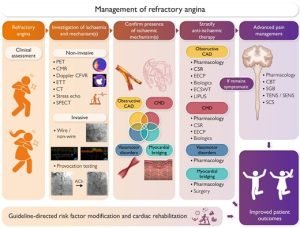
The diagnosis of refractory angina has conventionally been limited to patients with angina and ischaemia secondary to obstructive atherosclerotic epicardial coronary disease who experience persistent symptoms despite optimal pharmacological and revascularization therapies. It is now well-established that angina may also be caused by ischaemia resulting from coronary microcirculatory disorders, coronary vasospasm, and bridging in the absence of obstructive epicardial coronary disease or after “successful” revascularization.
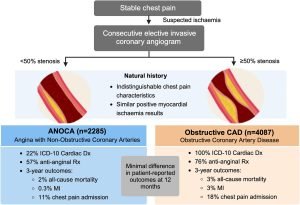
In patients undergoing invasive coronary angiography for the investigation of angina, the management pathways for obstructive coronary artery disease (CAD) are well described, whereas the clinical and diagnostic journey of patients with Angina with Non-Obstructive Coronary Arteries (ANOCA) has largely been inferred, as there is limited quantitative data. To compare the journey of patients with ANOCA vs. obstructive CAD, particularly in relation to (i) clinical presentation, and (ii) diagnostic assessment, (iii) 12 month patient-reported outcome measures, and (iv) 3-year composite major adverse cardiovascular events.
A substantial number of patients undergoing coronary angiography for angina or ischemia in noninvasive tests have coronary arteries without lesions or with nonsignificant stenosis. Many of these patients have nonobstructive myocardial ischemia (INOCA/ANOCA), which is an entity with prognostic importance that significantly affects patients’ quality of life.
The absence of a proper diagnosis leads to inappropriate medical treatment, repeat diagnostic tests, and greater use of social and health resources. An adequate diagnostic strategy is required for individualized treatment that improves symptoms and quality of life.

Introduction
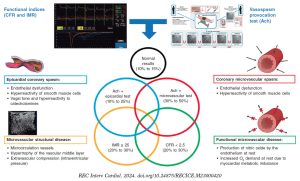
Angina with non-obstructive coronary arteries (ANOCA) remains a common clinical finding among patients undergoing invasive coronary angiography for the investigation of suspected ischaemic syndromes. ANOCA may result from coronary microvascular disease or vasospasm (microvascular or epicardial spasm), which may be diagnosed using comprehensive physiology testing such as invasive functional coronary angiography (FCA).
Current guidelines (European Society […]
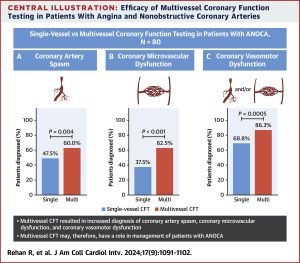
Invasive CFT is the gold standard for diagnosing coronary vasomotor dysfunction in patients with ANOCA. Most institutions recommend only testing the left coronary circulation. Therefore, it is unknown whether testing multiple coronary territories would increase diagnostic yield.
The aim of this study was to evaluate the diagnostic yield of multivessel, compared with single-vessel, invasive coronary function testing (CFT) in patients with angina and nonobstructive coronary arteries (ANOCA).

Ischemic heart disease continues to represent a major health threat for death, disability, and poor quality of life as it also consumes enormous health-related resources. For over a century, the major clinical phenotype was taken to be obstructive atherosclerosis involving the larger coronary arteries (e.g., coronary artery disease [CAD]). However, evolving evidence now indicates that nonobstructive CAD is the predominant phenotype.
Patients within this phenotype have been termed to have angina with no obstructive CAD (ANOCA), ischemia with no obstructive CAD (INOCA), or myocardial infarction with no obstructive coronary arteries (MINOCA). But as methods to assess cardiomyocyte injury evolve, these phenotypic distinctions have begun to merge, raising concern about their usefulness.

Nearly half of all patients with angina have non-obstructive coronary artery disease (ANOCA); this is an umbrella term comprising heterogeneous vascular disorders, each with disparate pathophysiology and prognosis. Approximately two-thirds of patients with ANOCA have coronary microvascular disease (CMD). CMD can be secondary to architectural changes within the microcirculation or secondary to vasomotor dysfunction.
An inability of the coronary vasculature to augment blood flow in response to heightened myocardial demand is defined as an impaired coronary flow reserve (CFR), which can be measured non-invasively, using imaging, or invasively during cardiac catheterisation. Impaired CFR is associated with myocardial ischaemia and adverse cardiovascular outcomes.

In February 2020, I had a VF cardiac arrest.
My memories start a week after the event when I awoke in ICU.
I was confused and initially unable to move. My family were at my bedside and told me what had happened.
Amazingly, I had survived not only the arrest, but also aspiration pneumonia, sepsis and a stage 3 acute kidney injury requiring dialysis.

I had my first heart attack in 2018. I was 67 years old.
After numerous trips to the hospital, tests, and frequent heart attack-like symptoms, I was diagnosed with Prinzmetal Angina and placed on medications.
I lost weight. I exercised. I was finally feeling better. I even got back to my painting.
Until…2019 happened.

My name is Arthur. I am a Scot but have lived in London for nearly forty years.
In 2014, I had my first heart attack. In the following six years, I went to A&E at least twice a year. Every time, I was sent home and was told it was reflux.
My own doctor in about 2015/16 put me on half an angina pill. When I was in hospital, I was told by the cardiology doctors that I did not need it as I never had angina at all.
Input your search keywords and press Enter.
