
Introduction
Refractory angina is conventionally diagnosed in patients with angina and demonstrable ischaemia secondary to obstructive epicardial coronary artery disease (CAD) that persists despite maximally tolerated guideline-directed pharmacological therapy and achievable revascularization. It is well-established, however, that angina can also result from ischaemia triggered by other mechanisms, including coronary microvascular dysfunction (CMD), epicardial or microvascular vasospasm, and myocardial bridging. These can occur in the presence or absence of obstructive epicardial CAD, and in patients with persistent angina despite successful coronary revascularization. Patients without flow-limiting CAD who have demonstrable ischaemia due to CMD or vasospasm and experience life-limiting angina fall outside the current definition of refractory angina. Furthermore, CMD and vasospasm can additionally occur in patients with obstructive epicardial CAD, but frequently remain under-recognized and under-treated. Focusing exclusively on obstructive CAD may misclassify patients as having refractory angina, as symptoms might improve with appropriate stratified treatment. Thus, in patients deemed to have refractory angina, it is necessary to evaluate comprehensively the potential pathophysiological mechanisms causing myocardial ischaemia.
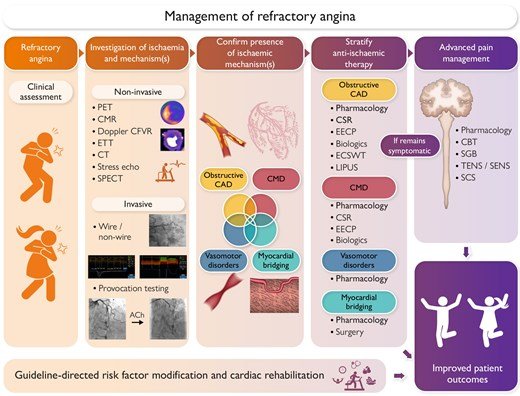
A re-definition of refractory angina is urgently needed to encompass the diversity of patients with angina encountered in contemporary clinical practice. In this article, approaches for the systematic non-invasive and invasive identification of ischaemic mechanisms arising from all compartments of the coronary circulation are proposed, emphasising the importance of quantitative methods. An approach to using results of these investigations to stratify treatment is suggested, understanding that multiple mechanisms may co-exist in an individual patient. An integrated approach combining established medical therapies for ischaemia, cardiac rehabilitation (CR), psychological therapies, and advanced pain management is proposed. Building on previous work, a more inclusive definition of refractory angina is suggested together with a model of care, delivered by a specialist inter-disciplinary Angina Heart Team, which may best address the complex needs of patients with refractory angina leading to improved symptoms, quality of life, and clinical outcomes.


