
Alphabetical list of abbreviations
- ACS
- Acute Coronary Syndrome
- ACh
- Acetylcholine
- ARBs
- Angiotensin Receptor Blockers
- CAD
- Coronary Artery Disease
- CCBs
- Calcium-Channel Blockers
- CCS
- Chronic Coronary Syndrome
- CFR
- Coronary Flow Reserve
- CMR
- Cardiac Magnetic Resonance
- CMD
- Coronary Microvascular Dysfunction
- CVD
- Cardiovascular Disease
- CV
- Cardiovascular
- DAPT
- Dual Antiplatelet Therapy
- DPI
- Dual-Pathway Inhibition
- ECG
- Electrocardiogram
- HPR
- High Platelet Reactivity
- IHD
- Ischemic Heart Disease
- IMR
- Index of Microvascular Resistance
- INOCA
- Ischemia and Non-Obstructed Coronary Artery
- IVUS
- Intravascular Ultrasound
- LPR
- Low Platelet Reactivity
- LoF
- Loss-of-Function
- MACE
- Major Adverse Cardiovascular Events
- MI
- Myocardial Infarction
- MINOCA
- Myocardial Infarction with Non-Obstructed Coronary Arteries
- MVA
- Microvascular Angina
- NACE
- Net Adverse Clinical Events
- NSTE
- Non-ST Elevation
- OCT
- Optical Coherence Tomography
- PCI
- Percutaneous Coronary Intervention
- RCT
- Randomized Controlled Trial
- SCAD
- Spontaneous Coronary Artery Dissection
- STEMI
- ST-Elevation Myocardial Infarction
- TLR
- Target Lesion Revascularization
- VSA
- Vasospastic Angina
Introduction
Ischemic heart disease (IHD) still represents the leading cause of disability and mortality worldwide despite a > 50% reduction in IHD-related mortality over the last 50 years. This falling IHD-related mortality is associated with the implementation of international guidelines including early identification and treatment of traditional cardiovascular (CV) disease (CVD) risk factors. The traditional approach to CVD relies on grouping patients presenting with common signs and symptoms into clinical pathways, such for stable angina. These large subpopulations are uniformly treated in accordance with evidence-based guidelines. This approach enables allocation of patients at scale to treatments shown to be effective and acceptably safe in clinical trials often involving large numbers of people. Emerging evidence mainly from other fields of Medicine, suggests that this approach may have, at least in part, exhausted improvements in clinical outcomes of patients with IHD. One of the reasons for this may be that most medical treatments are designed for the “average” patient, as in a “one-size-fits-all” approach, which may be efficacious in some patients but not in others. Yet, as a specific phenotype can be caused by different pathogenetic mechanisms, an effective treatment may require a targeted approach. For instance, the phenotype “anaemia” can be caused by iron deficiency or myeloproliferative disorders and clearly, the treatments are different.
Precision medicine holds promise tailoring the right treatment to the right patient at the right time. It combines data from time honoured sources (e.g., history, physical examination, imaging, laboratory) and those provided by multi-omics technologies (e.g., metabolomic, proteomic, next-generation sequencing analyses enabling genome, transcriptome, DNA-protein interaction profiling) to identify homogeneous subsets of patients and apply specific treatments. Although other medical specialties such as oncology, haematology and immunology have been integrating these tools into diagnostic and therapeutic algorithms for decades, this integrative approach is not being widely applied in IHD. Multiple factors contributed to slower precision medicine in IHD. Indeed, IHD encompasses a range of conditions with significant disease complexity and clinical heterogeneity, making the development of unified stratification approaches more challenging compared to other diseases (i.e., cancer). However, several adjunctive investigations including cardiac biomarkers, non-invasive and invasive diagnostic techniques are available in patients with IHD. These methods permit identification of specific pathogenic mechanisms on an individual patient basis, enabling the possibility of treatment stratification according to the disease process. If precision medicine is not yet ready for current clinical practice for IHD patients, a “stratified medicine” approach represents an initial step forward. ‘Stratified medicine’ is defined as the grouping of patients based on risk of disease or response to therapy by using diagnostic tests or techniques. Of importance, stratified medicine in IHD has the potential to improve patients’ outcomes by enabling an earlier and more accurate diagnosis as well as a timely and targeted treatment with potentially higher efficacy and fewer adverse effects. Furthermore, it could allow a more efficient allocation of healthcare resources by reducing unnecessary treatments and costs.
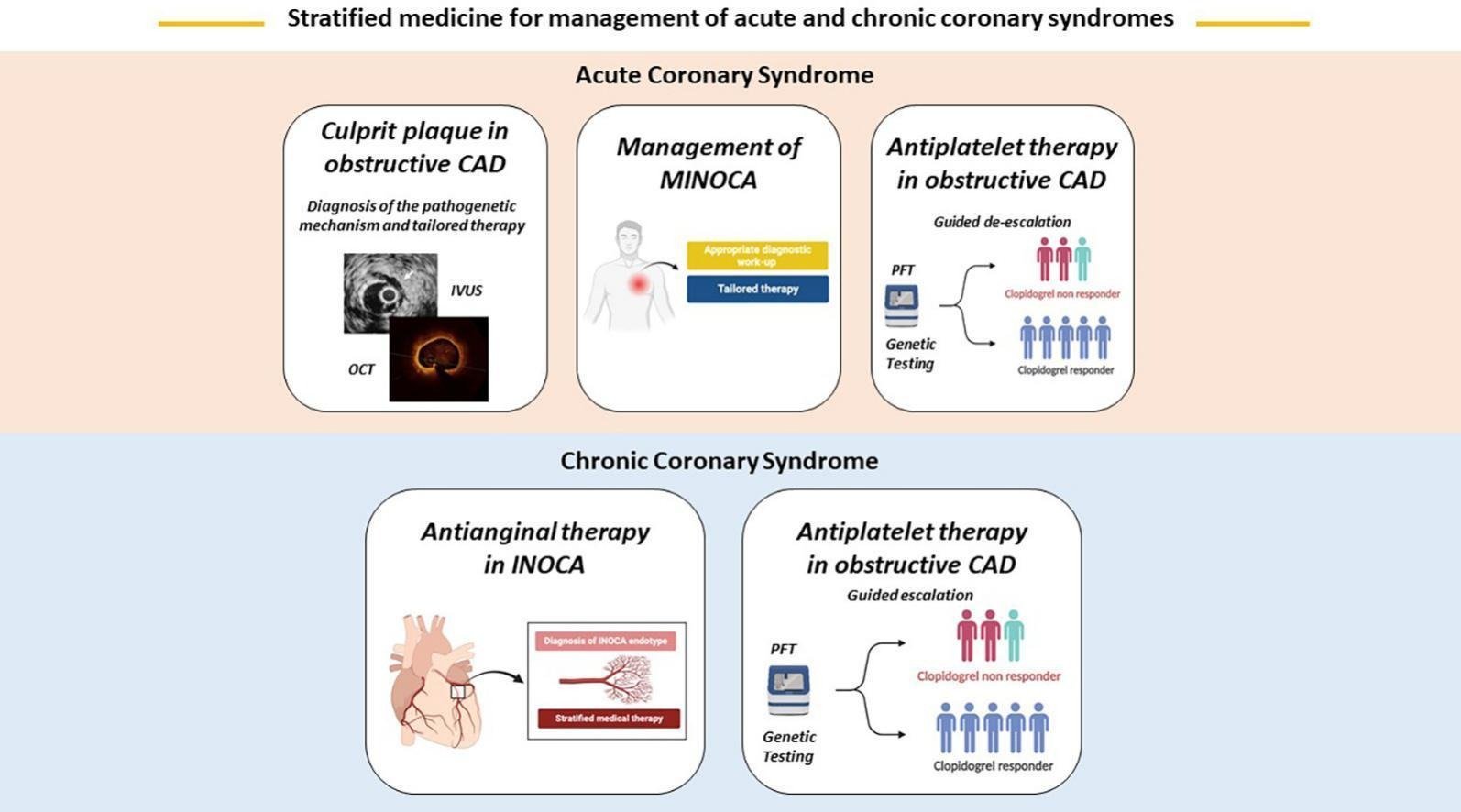
The purpose of this review is to provide updated evidence on potential strategies for the application of stratified medicine to the management of both patients with acute coronary syndrome (ACS) and chronic coronary syndrome (CCS).


