Tag: stratified medicine

Research

Stratified treatment of myocardial infarction with non-obstructive coronary arteries: the...

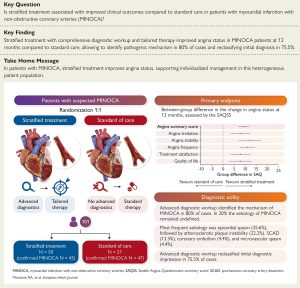
Myocardial infarction with non-obstructive coronary arteries (MINOCA) is associated with a significant risk of mortality, rehospitalization, and angina burden. Despite its clinical impact, no randomized clinical trials have hitherto evaluated optimal management strategy for MINOCA. The PROMISE trial was designed to assess whether a stratified treatment improves clinical outcomes in patients with MINOCA as compared to standard care.
Read More »
Research

Functional Coronary Angiography for the Diagnosis of Coronary Vasomotor Disorders

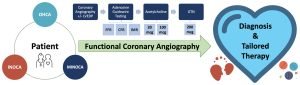
Microvascular and/or vasospastic angina are two common forms of coronary vasomotor disorders that may occur in patients with ischaemia and non-obstructed coronary arteries (INOCA) or myocardial infarction with non-obstructive coronary arteries (MINOCA).

Functional coronary angiography involves invasive guidewire-based assessment of the coronary circulation using pharmacological vasoactive agents to assess small and large vasomotor dysfunction. Typically, responses to adenosine (microvascular vasodilator) and acetylcholine (large and small vessel vasospastic agent) are sequentially assessed.

Read More »
Research

Stratified medicine for acute and chronic coronary syndromes: A patient-tailored...

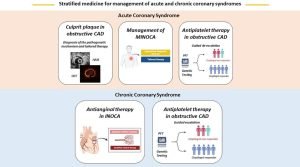
The traditional approach to management of cardiovascular disease relies on grouping clinical presentations with common signs and symptoms into pre-specified disease pathways, all uniformly treated according to evidence-based guidelines (“one-size-fits-all”). The goal of precision medicine is to provide the right treatment to the right patients at the right time, combining data from time honoured sources (e.g., history, physical examination, imaging, laboratory) and those provided by multi-omics technologies. In patients with ischemic heart disease, biomarkers and intravascular assessment can be used to identify endotypes with different pathophysiology who may benefit from distinct treatments. This review discusses strategies for the application of stratified management to patients with acute and chronic coronary syndromes.

Read More »
Research

1-Year Outcomes of Angina Management Guided by Invasive Coronary Function...

The aim of this study was to test the hypothesis that invasive coronary function testing at time of angiography could help stratify management of angina patients without obstructive coronary artery disease. Medical therapy for angina guided by invasive coronary vascular function testing holds promise, but the longer-term effects on quality of life and clinical events are unknown among patients without obstructive disease.

A total of 151 patients with angina with symptoms and/or signs of ischemia and no obstructive coronary artery disease were randomized to stratified medical therapy guided by an interventional diagnostic procedure versus standard care (control group with blinded interventional diagnostic procedure results).

Read More »
Research

Assessment of Vascular Dysfunction in Patients Without Obstructive Coronary Artery...

Ischemic heart disease secondary to coronary vascular dysfunction causes angina and impairs quality of life and prognosis. About one-half of patients with symptoms and signs of ischemia turn out not to have obstructive coronary artery disease, and coronary vascular dysfunction may be relevant.

Adjunctive tests of coronary vasomotion include guidewire-based techniques with adenosine and reactivity testing, typically by intracoronary infusion of acetylcholine. The CorMicA (Coronary Microvascular Angina) trial provided evidence that routine management guided by an interventional diagnostic procedure and stratified therapy improves angina and quality of life in patients with angina but no obstructive coronary artery disease.

Read More »
Around The World

Real Patient Stories

Rene’s story

I had my first heart attack in 2018. I was 67 years old.

After numerous trips to the hospital, tests, and frequent heart attack-like symptoms, I was diagnosed with Prinzmetal Angina and placed on medications.

I lost weight. I exercised. I was finally feeling better. I even got back to my painting.

Until…2019 happened.

Read More »

Lynn’s story

I had my first spasm when I was just a young child and continued for almost 50 years with no diagnosis. I always assumed everybody had flushing feelings throughout their body, and hot flashes accompanied by chest pain.

It wasn’t until I was walking my dogs with my sister, one day, and we were going up a steep incline and I couldn’t keep up. I asked her if she felt chest pains when she walked up hills. She looked at me like I was crazy and told me: No!

I then realized something might be wrong with me.

Read More »

Barbara’s story

I am a 62-year-old retired physician. My story began at age 47.

I was a very busy practicing OB/Gyn physician who was otherwise healthy.

I was on call at the hospital, and it was turning out to be one of the busiest days I had ever experienced as a physician. I was in a medical group that took call for 24 hours straight, most of the time working the entire 24 hours.

Halfway through that 24-hour call, I was in the operating room doing a C/Section on a patient. Halfway through the surgery I began to feel crushing chest pain.

Read More »

Get Informed

Learn all about the symptoms, causes and triggers of these heart conditions.

Educate. Inform. Enlighten.