
Introduction
Nearly half of all patients undergoing coronary angiography for stable angina are found to have nonobstructive coronary arteries. Invasive coronary function testing (CFT), using acetylcholine (ACh) to diagnose coronary artery spasm (CAS) and a pressure-temperature sensing guide wire to evaluate for coronary microvascular dysfunction (CMD), is considered the gold standard for evaluating patients with angina with nonobstructive coronary arteries (ANOCA). These investigations carry a class Ib recommendation in the European Society of Cardiology guidelines, supporting a tailored therapeutic approach that has been shown to enhance angina control and improve quality of life.
The optimal sequence for CFT remains a subject of debate, with many centers opting to perform ACh provocation testing as the initial step. In this approach, nitroglycerin (NTG) is administered after CAS testing, followed by insertion of an intracoronary pressure wire and administration of adenosine for CMD assessment. Conversely, other clinicians advocate for CMD testing first, as they believe that ACh-induced spasm may alter baseline microvascular resistance and overall coronary flow, potentially compromising the accuracy of those results. This alternative approach requires NTG administration prior to ACh provocation, which can potentially lead to a false negative test for CAS. Furthermore, the widespread adoption of radial access in most catheterization laboratories, where intraradial NTG and/or calcium channel blockers are routinely administered to prevent radial artery spasm, may obscure accurate assessment of CAS. Although NTG is considered short-acting, its administration following radial access but prior to ACh testing may further contribute to the underdiagnosis of CAS.
Given these differing perspectives, the exact sequence of steps during CFT varies across centers and there is no consensus on the optimal protocol. This study aims to evaluate the diagnostic impact of preceding intravascular NTG on ACh provocation testing.
Methods
This multicenter, prospective study assessed the effect of intravascular NTG on ACh provocation testing in ANOCA patients from August 2022 to June 2024 (https://anzctr.org.au/; Unique identifier: ACTRN12622001521718). All patients were referred by their treating cardiologist for suspected ANOCA. Diagnostic invasive coronary angiography was performed to confirm the absence of obstructive coronary artery disease in all patients, defined as a diameter stenosis of less than 50% by visual estimation. Patients underwent ACh provocation testing in the left (LCA) and right (RCA) coronary arteries followed by adenosine-mediated coronary physiology assessment (Supplemental Table S1) with a minimum interval of 10 minutes between both procedures. For safety reasons, ACh provocation testing was avoided in cases where the coronary arteries were nondominant, or severely tortuous. Patients were eligible for inclusion if they had evidence of epicardial CAS confirmed by ACh provocation testing. Exclusion criteria included recent (within 3 weeks before cardiac catheterization) acute coronary syndrome, prior heart transplantation, coronary artery bypass grafting, serum creatinine >1.5 mg/dL, and/or inability to provide informed consent.
Clinical data on patient characteristics, cardiac risk factors, and symptom profiles were collected prior to the procedure. Both traditional cardiovascular risk factors and nontraditional variables associated with vasomotor disorders were documented. The study protocol adhered to the ethical guidelines of the 1975 Declaration of Helsinki and received approval from the human research ethics review board. Written informed consent was obtained from all participants. R.R. and A.S.C.Y. had full access to all study data and were responsible for ensuring data integrity and conducting the analysis.
ACh provocation testing protocol
All ACh provocation testing was conducted in the morning to ensure standardized patient timing. Patients were requested to withhold vasoactive medications (eg, calcium channel blockers and long-acting nitrates) and substances containing methylxanthine for >4 times the duration of the drug half-life. Continuous 12-lead electrocardiogram (ECG) monitoring was employed throughout the procedure. Diagnostic invasive coronary angiography was performed per standard institutional practice via the radial or femoral artery. Administration of intravascular vasodilator drugs (eg, NTG, calcium channel blockers) was avoided following initial arterial access prior to ACh provocation testing in all patients. After confirming the absence of obstructive coronary artery disease, multivessel ACh provocation testing was conducted.
To compensate for potential bradycardia, a temporary transvenous pacemaker was inserted via the femoral vein, activated only if a pause exceeding 5 seconds occurred. A 6F angioplasty guiding catheter without side holes was then positioned in either the LCA or RCA, guided by clinical judgment. For the LCA assessment, incremental doses of 20, 50, 100, and 200 μg of ACh were injected over 20 seconds, with a 2-minute gap between doses. After each injection, cine-images were obtained to assess changes in coronary diameter through quantitative coronary angiography offline using standard commercial software on a Leonardo workstation (Quant, Siemens), which is derived from the CAAS II system (Pie Medical Imaging). If CAS was induced with reproducible symptoms and ST-segment changes (see definitions below), the provocation test was terminated and concluded to be positive. For the RCA, a similar protocol was followed with incremental doses of 20, 50, and 80 μg of ACh. Intracoronary NTG was administered to reverse the effects of ACh following the completion of testing.
ACh rechallenge protocol
To assess the reinducibility of epicardial spasm, the ACh rechallenge was performed in patients who tested positive by readministering the spasm provocation dose into the affected coronary artery. Following the administration of intraradial NTG (200 μg), the ACh rechallenge was performed at 5 minutes, with a second challenge at 10 minutes if no epicardial spasm was detected during the initial assessment (Figure 1). Patient symptoms, ischemic ECG changes, and coronary artery diameter reduction were monitored similarly to the initial assessment. Patients with an indeterminate result during the ACh rechallenge, defined as symptom reproduction without either >90% vasoconstriction or ECG changes, were categorized as having no spasm.
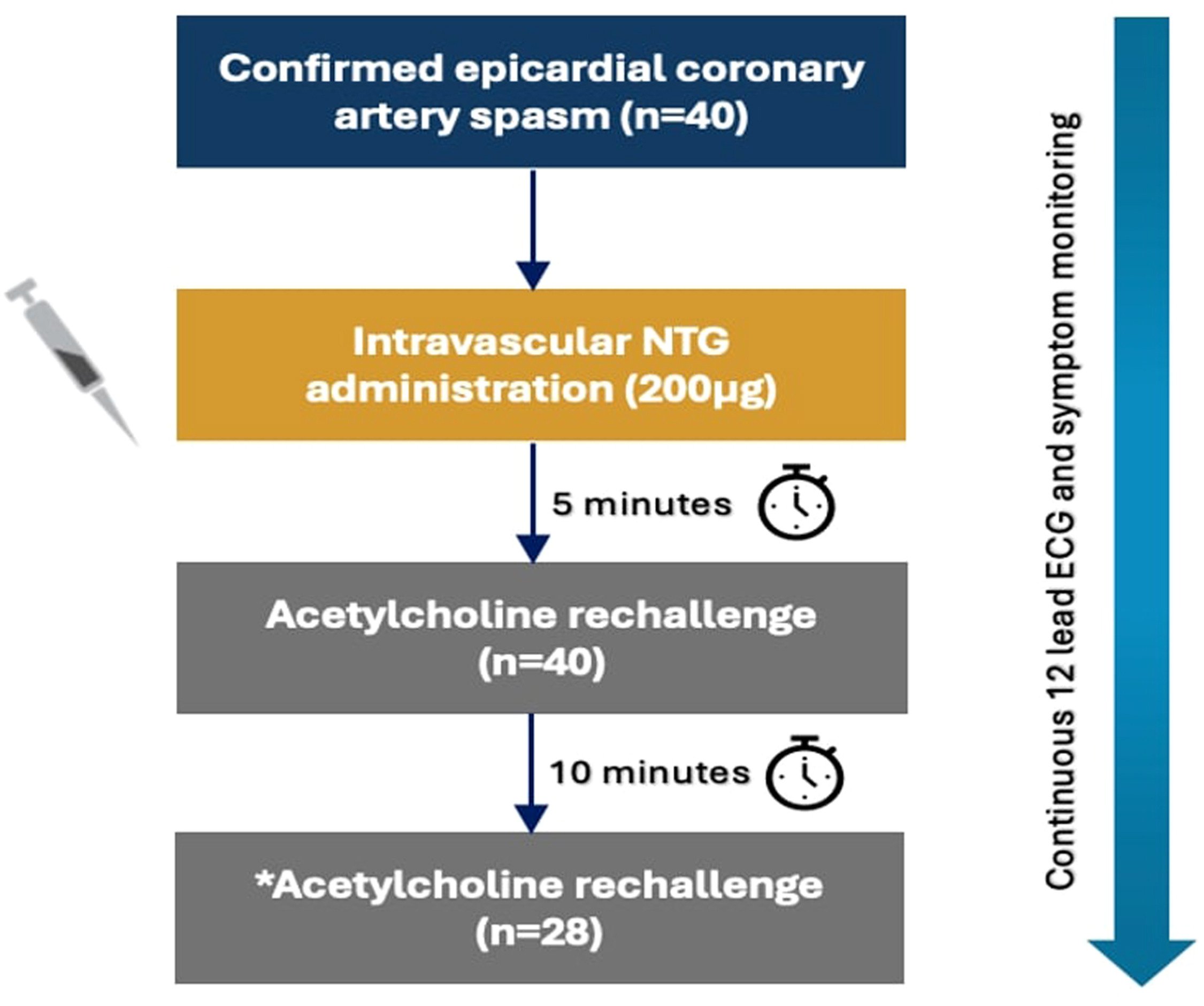
Figure 1 Study flowchart. Protocol for acetylcholine (ACh) rechallenge in patients with confirmed epicardial coronary artery spasm. ∗Only patients (n = 28) who did not demonstrate epicardial coronary artery spasm at the 5-minute ACh rechallenge proceeded to the 10-minute ACh rechallenge. ECG, electrocardiogram, NTG, nitroglycerin.


