Tag: women

Research

Societal, occupational, and economic considerations for women with (M)INOCA: a...

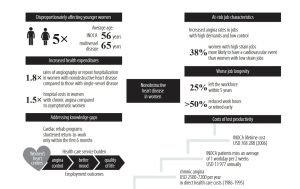
Cardiovascular disease is one of the leading causes of mortality in women, despite underrepresentation in the medical literature. Women have higher rates of ischemia and no obstructive coronary artery disease (INOCA) and myocardial infarction with no obstructive coronary artery disease (MINOCA) compared to men. The aim of this review is to describe the occupational, economic, and psychosocial factors which disproportionately impact women with (M)INOCA.
Read More »
Research

Advancing the access to cardiovascular diagnosis and treatment among women...

Despite significant progress in cardiovascular pharmacotherapy and interventional strategies, cardiovascular disease (CVD), in particular ischaemic heart disease, remains the leading cause of morbidity and mortality among women in the UK and worldwide. Women are underdiagnosed, undertreated and under-represented in clinical trials directed at management strategies for CVD, making their results less applicable to this subset.

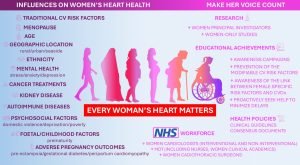
Women have additional sex-specific risk factors that put them at higher risk of future cardiovascular events. Psychosocial risk factors, socioeconomic deprivation and environmental factors have an augmented impact on women’s cardiovascular health, highlighting the need for a holistic approach to care that considers risk factors specifically related to female biology alongside the traditional risk factors.

Read More »
Research

Raising awareness about cardiovascular disease in women

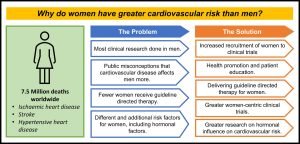
Each year, cardiovascular disease maintains its status as the leading cause of morbidity and mortality in women. In their most recent published statistics, the World Health Organization showed that ischaemic heart disease, stroke, and hypertension resulted in over 7.5 million deaths in women globally in 2019.

This trend is similar to the mortality burden in men and is echoed by countries worldwide. Despite this, there remains a significant male predominance in practically all clinical trials measuring the safety and efficacy of investigations and management of cardiovascular disease, which ultimately directs clinical guidelines.

Read More »
Research

Secondary Prevention of Cardiovascular Disease in Women: Closing the Gap

Cardiovascular disease (CVD) remains the leading cause of death in women globally. Younger women (<55 years of age) who experience MI are less likely to receive guideline-directed medical therapy (GDMT), have a greater likelihood of readmission and have higher rates of mortality than similarly aged men. Women have been under-represented in CVD clinical trials, which limits the generalisability of results into practice. Available evidence indicates that women derive a similar benefit as men from secondary prevention pharmacological therapies, such as statins, ezetimibe, proprotein convertase subtilisin/kexin type 9 inhibitors, icosapent ethyl, antiplatelet therapy, sodium–glucose cotransporter 2 inhibitors and glucagon-like peptide-1 receptor agonists. Women are less likely to be enrolled in cardiac rehabilitation programs than men.

Read More »
News

Improving the Diagnosis of Heart Disease in Women

Dr. Shah’s team is studying 100 women over two years who get referred for coronary angiography to Yale New Haven Hospital and comparing outcomes for patients who receive the standard care with those undergoing the cutting-edge tests to detect coronary microvascular disease or vasospasm. His goal is to show the value of the new tests, already covered by insurance, so they become the standard of care for patients — mostly women — who have reduced blood flow to the heart but no obstruction.

Dr. Samit Shah has seen it too often. Women come to a hospital Emergency Department or doctor’s office complaining of chest pain, shortness of breath, nausea, lightheadedness, jaw pain, or other symptoms considered concerning for a heart problem. The women might undergo standard testing to see if they have a critical cholesterol blockage in their arteries, the hallmark of obstructive coronary artery disease.

Read More »
Research

Treatment of coronary microvascular dysfunction

Contemporary data indicate that patients with signs and symptoms of ischaemia and non-obstructive coronary artery disease (INOCA) often have coronary microvascular dysfunction (CMD) with elevated risk for adverse outcomes. Coronary endothelial (constriction with acetylcholine) and/or microvascular (limited coronary flow reserve with adenosine) dysfunction are well-documented, and extensive non-obstructive atherosclerosis is often present.

Despite these data, patients with INOCA currently remain under-treated, in part, because existing management guidelines do not address this large, mostly female population due to the absence of evidence-based data.

Read More »
Around The World

Real Patient Stories

Don’s story

I consider myself one of the lucky ones.

I was a runner, triathlete, skier, scuba diver, etc. before my problems got severe enough to seek medical help.

Most doctors took my health decline seriously from the start.

Later, it was not uncommon for doctors who were unaware of my athletic endeavours to assume my subsequent lack of fitness was the cause of my condition rather than the result.

Read More »

Charlotte’s story

While at work in September 2014, I lost vision of my left eye and had terrible feeling of “heat” all over the left side of my body.

The ER ophthalmologist directed me to cardiology for a vascular problem.

A week later, I could not walk 100 meters (325 feet) without crushing chest pain and shortness of breath.

I was no longer functional. Making my bed was all I could do in a whole day. I was no longer an active 54-year-old.

Read More »

Lynn’s story

I had my first spasm when I was just a young child and continued for almost 50 years with no diagnosis. I always assumed everybody had flushing feelings throughout their body, and hot flashes accompanied by chest pain.

It wasn’t until I was walking my dogs with my sister, one day, and we were going up a steep incline and I couldn’t keep up. I asked her if she felt chest pains when she walked up hills. She looked at me like I was crazy and told me: No!

I then realized something might be wrong with me.

Read More »

Get Informed

Learn all about the symptoms, causes and triggers of these heart conditions.

Educate. Inform. Enlighten.