Tag: coronary spasm

Research

Endotypes of angina with non-obstructive coronary arteries: a prospective multicentre...

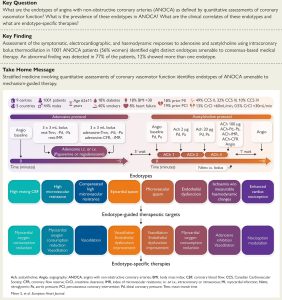
Angina and/or myocardial ischaemia with non-obstructive coronary arteries (ANOCA/INOCA) affects more than one in three individuals with stable ischaemic heart disease, and women are more often affected. This high prevalence of ANOCA, its impact on health-related quality of life and prognosis, and evidence supporting the role of invasive coronary function tests in persistently symptomatic patients have led to a class I recommendation in international practice guidelines and a call for further research into the diagnosis of this condition. As underlined in these guidelines, ANOCA/INOCA is ‘rarely correctly diagnosed and no tailored therapy is prescribed for these patients.’
Read More »
Research

Current Evidence-Based Treatment of Angina With Nonobstructive Coronary Arteries (ANOCA)

Although the techniques for coronary function testing (CFT) were largely developed more than 30 years ago, consensus on the specific diagnostic criteria and endotypes is still lacking. Furthermore, the management of patients with angina with nonobstructive coronary arteries (ANOCA) is challenging for most cardiologists. These patients are often a burden to the health care system due to recurrent presentations to the emergency room, repeated coronary angiography, and lack of improvement in their anginal symptoms even after being properly diagnosed with CFT.

Read More »
Research

Air Pollution and Coronary Vasomotor Disorders in Patients With Myocardial...

Coronary vasomotor abnormalities are important causes of myocardial ischemia in patients with nonobstructive coronary artery disease (NOCAD). However, the role of air pollution in determining coronary vasomotor disorders has never been investigated.

We aimed to evaluate the association between long-term exposure to particulate matter 2.5 (PM2.5) and 10 (PM10), and coronary vasomotor disorders in NOCAD patients.

Read More »
Research

Pathophysiology of Coronary Microvascular Dysfunction

Ischemic heart disease (IHD) is commonly recognized as the consequence of coronary atherosclerosis and obstructive coronary artery disease (CAD). However, a significant number of patients may present angina or myocardial infarction even in the absence of any significant coronary artery stenosis and impairment of the coronary microcirculation has been increasingly implicated as a relevant cause of IHD.

The term “coronary microvascular dysfunction” (CMD) encompasses several pathogenic mechanisms resulting in functional and/or structural changes in the coronary microcirculation and determining angina and myocardial ischemia in patients with angina without obstructive CAD (“primary” microvascular angina), as well as in several other conditions, including obstructive CAD, cardiomyopathies, Takotsubo syndrome and heart failure, especially the phenotype with preserved ejection fraction.

Read More »
Research

Interplay Between Myocardial Bridging and Coronary Spasm in Patients With...

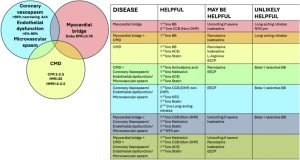
Myocardial bridging (MB) may represent a cause of myocardial ischemia in patients with non‐obstructive coronary artery disease (NOCAD). Herein, we assessed the interplay between MB and coronary vasomotor disorders, also evaluating their prognostic relevance in patients with myocardial infarction and non‐obstructive coronary arteries (MINOCA) or stable NOCAD.

We prospectively enrolled patients with NOCAD undergoing intracoronary acetylcholine provocative test. The incidence of major adverse cardiac events, defined as the composite of cardiac death, non‐fatal myocardial infarction, and rehospitalization for unstable angina, was assessed at follow‐up.

Read More »
Research

The Who, What, Why, When, How and Where of Vasospastic...

Ischemic heart disease involves both “structural” and/or “functional” disorders of the coronary circulation. Structural atherosclerotic coronary artery disease (CAD) is well recognized, with established diagnostic and treatment strategies. In contrast, “functional CAD” has received limited attention and is seldom actively pursued in the investigation of ischemic heart disease.

Vasospastic angina encompasses “functional CAD” attributable to coronary artery spasm and this “state of the art” consensus statement reviews contemporary aspects of this disorder.

Read More »
Around The World

Real Patient Stories

Lynn’s story

I had my first spasm when I was just a young child and continued for almost 50 years with no diagnosis. I always assumed everybody had flushing feelings throughout their body, and hot flashes accompanied by chest pain.

It wasn’t until I was walking my dogs with my sister, one day, and we were going up a steep incline and I couldn’t keep up. I asked her if she felt chest pains when she walked up hills. She looked at me like I was crazy and told me: No!

I then realized something might be wrong with me.

Read More »

Sandra’s story

My story began in January 2010, while sitting at a traffic light returning to the office. I was working as a home health physical therapist. I began having chest pain out of nowhere. I got to my office and my boss, an RN, asked me if I was OK. I told her about the chest pain. By then it was starting to progress down my left arm. She took my blood pressure, normally 98/68. It was 140/90. She called my husband and told him to meet me at the ER. I drove myself there. They ran the normal tests and diagnosed me with costochondritis. Pain meds made the symptoms go away. The pain came back six times in the next 6 months. I asked for a cardiologist referral, but was denied, due to my age (39), lack of family history, and being in shape.

Read More »

Mary’s story

First came the headaches – worse than migraines – then the shortness of breath and having to lay down after crossing the room.

Five months after my symptoms began, I was diagnosed with a 99% blockage in my LAD and 99% blockage in an artery branch off that.

I was stented and, in doing so, they jailed an artery. I was given Metoprolol and I got worse.

I underwent another Angiogram, and all was fine, so they changed my medication and I began to use my Nitro more.

Read More »

Get Informed

Learn all about the symptoms, causes and triggers of these heart conditions.

Educate. Inform. Enlighten.