Tag: atherosclerosis

Research

2024 ESC Guidelines for the management of chronic coronary syndromes:...

Guidelines evaluate and summarize available evidence with the aim of assisting health professionals in proposing the best diagnostic or therapeutic approach for an individual patient with a given condition. Guidelines are intended for use by health professionals, and the European Society of Cardiology (ESC) makes its guidelines freely available.

ESC Guidelines do not override the individual responsibility of health professionals to make appropriate and accurate decisions in consideration of each patient’s health condition and in consultation with that patient or the patient’s caregiver where appropriate and/or necessary. It is also the health professional’s responsibility to verify the rules and regulations applicable in each country to drugs and devices at the time of prescription and to respect the ethical rules of their profession.

Read More »
Research

Coronary microvascular dysfunction in stable ischaemic heart disease

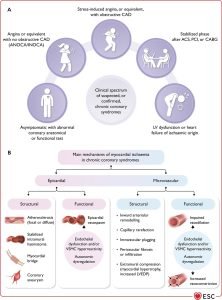
Diffuse and focal epicardial coronary disease and coronary microvascular abnormalities may exist side-by-side. Identifying the contributions of each of these three players in the coronary circulation is a difficult task.

Yet identifying coronary microvascular dysfunction (CMD) as an additional player in patients with coronary artery disease (CAD) may provide explanations of why symptoms may persist frequently following and why global coronary flow reserve may be more prognostically important than fractional flow reserve measured in a single vessel before percutaneous coronary intervention.

Read More »
Research

Treatment of coronary microvascular dysfunction

Contemporary data indicate that patients with signs and symptoms of ischaemia and non-obstructive coronary artery disease (INOCA) often have coronary microvascular dysfunction (CMD) with elevated risk for adverse outcomes. Coronary endothelial (constriction with acetylcholine) and/or microvascular (limited coronary flow reserve with adenosine) dysfunction are well-documented, and extensive non-obstructive atherosclerosis is often present.

Despite these data, patients with INOCA currently remain under-treated, in part, because existing management guidelines do not address this large, mostly female population due to the absence of evidence-based data.

Read More »
Around The World

Real Patient Stories

Sandra’s story

My story began in January 2010, while sitting at a traffic light returning to the office. I was working as a home health physical therapist. I began having chest pain out of nowhere. I got to my office and my boss, an RN, asked me if I was OK. I told her about the chest pain. By then it was starting to progress down my left arm. She took my blood pressure, normally 98/68. It was 140/90. She called my husband and told him to meet me at the ER. I drove myself there. They ran the normal tests and diagnosed me with costochondritis. Pain meds made the symptoms go away. The pain came back six times in the next 6 months. I asked for a cardiologist referral, but was denied, due to my age (39), lack of family history, and being in shape.

Read More »

Barbara’s story

I am a 62-year-old retired physician. My story began at age 47.

I was a very busy practicing OB/Gyn physician who was otherwise healthy.

I was on call at the hospital, and it was turning out to be one of the busiest days I had ever experienced as a physician. I was in a medical group that took call for 24 hours straight, most of the time working the entire 24 hours.

Halfway through that 24-hour call, I was in the operating room doing a C/Section on a patient. Halfway through the surgery I began to feel crushing chest pain.

Read More »

Charlotte’s story

While at work in September 2014, I lost vision of my left eye and had terrible feeling of “heat” all over the left side of my body.

The ER ophthalmologist directed me to cardiology for a vascular problem.

A week later, I could not walk 100 meters (325 feet) without crushing chest pain and shortness of breath.

I was no longer functional. Making my bed was all I could do in a whole day. I was no longer an active 54-year-old.

Read More »

Get Informed

Learn all about the symptoms, causes and triggers of these heart conditions.

Educate. Inform. Enlighten.